
Cyclic Simple Shear
Need and Scope:
Cyclic Simple Shear test is used to investigate the dynamic behavior of soils. It has some advantages over the cyclic triaxial testing as loading mechanism better simulates the earthquake conditions. Also the consolidation is anisotropic thereby simulating the at rest conditions in the field. The test is used to study the cyclic response of both the fine grained and coarse grained soils. The cyclic behavior can be investigated either by keeping the vertical stress constant or consolidated height constant during the cyclic loading.
Concept:
Cyclic simple shear test has been predominantly used to study the liquefaction characteristics under constant volume drained conditions wherein the any change in normal stress is equivalent to the change in effective stress and is equal to the excess pore water pressure that would occur in an otherwise truly undrained test. Dynamic properties are evaluated in either undisturbed or reconstituted states by using either stress or strain controlled cyclic simple shear device.
Unsymmetrical wave forms under both the stress and strain control, non-uniformity of pulse duration, load fall-off at large strains must not exceed tolerances.
Cyclic Simple Shear
Experimental Setup:
- Shear Load Cell
- Horizontal LVDT
- Vertical Load Cell
- Axial LVDT
- Axial LVDT (Long Range)
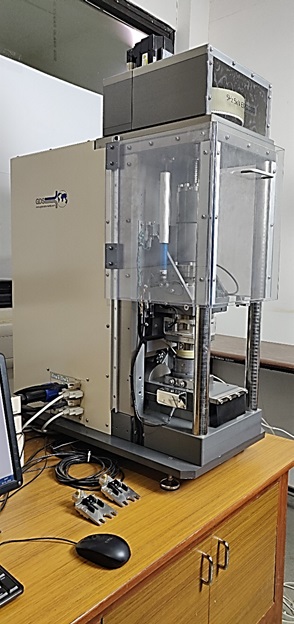
Cyclic Simple Shear Setup
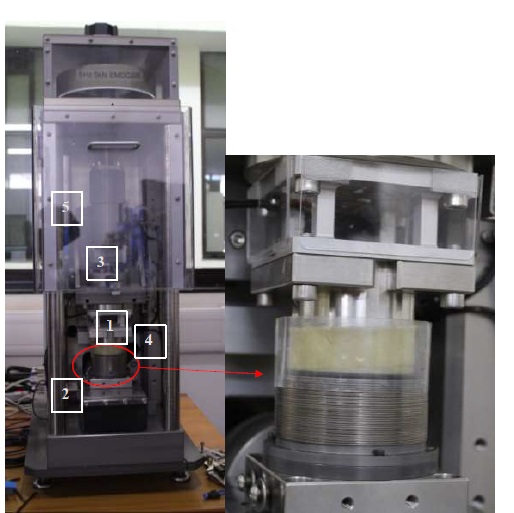
Solid cylindrical specimen surrounded by rings
Testing procedure (ASTM D 6528-07):
- The test can be performed on both the intact and reconstituted specimens
- Intact specimens should be trimmed to the lateral dimension of confinement device (70 mm)
- Reconstituted specimens prepared at the required density can be tested both at unsaturated and saturated conditions
- Saturation of the specimens can be achieved by pushing water through the bottom of the specimen under a hydrostatic head of up to 1 m
- Anisotropic consolidation of the specimens is achieved under a desired vertical stress by creating Advanced Shear Box stage in GDSLAB Device Module and the change in height is measured by the axial LVDTs
- Consolidated specimens are then subjected to
- Strain Control
- Stress Control
Under - Constant consolidated height
- Constant vertical stress
At a desired loading frequency (0.0001 to5 Hz) and loading amplitude (± 8mm fort strain control and 5 kN for stress control)
- The test stops itself as per the inputs given during creation of various stages (max. test time, Mac. Vertical stress, Number of cycles, Max. shear strain)
Strain Control Cyclic Simple Shear Testing
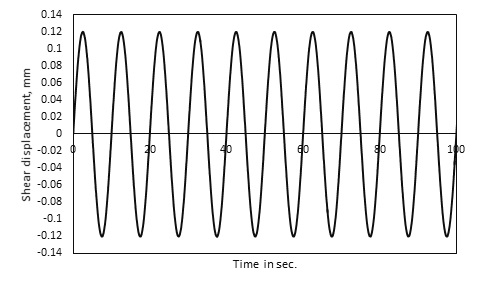
Input Loading
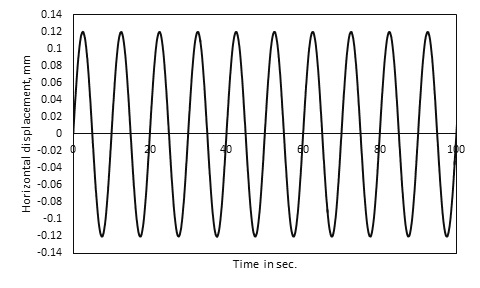
Horizontal displacement= 0.12 mm
??v = 100 kPa
Frequency= 0.1 Hz
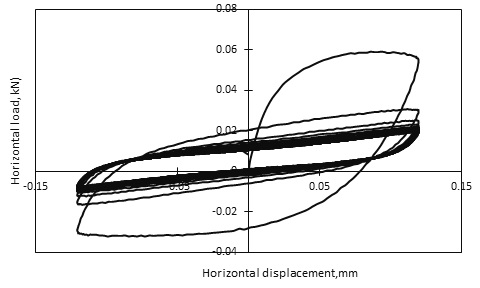
Output Loading
Analysis
Stress Control Cyclic Simple Shear Testing
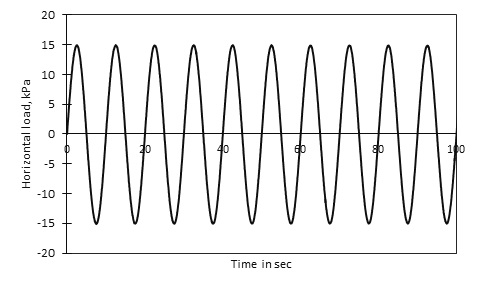
Input loading
CSR = 0.15
??v = 100 kPa
Frequency = 0.1 Hz
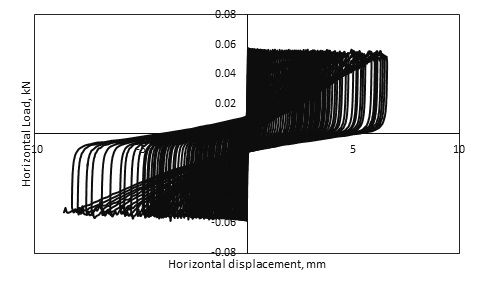
Output Loading
Analysis
Cyclic Simple Shear
Data Analysis:
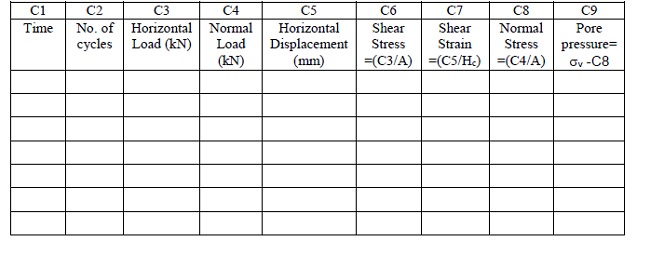
Observation Sheet for controlled Cyclic Simple Shear Test (Constant volume):
Weight of Sample: ………………………. In-situ Density: ……………………….
Initial Water Content: ……………………….
Diameter: ………………………. Area (A): ……………………….
Volume: ……………………….
Axial Displacement during consolidation: ……………………….
Height after consolidation:
Frequency of cyclic loading (Hz): ……………………….
Amplitude of cyclic loading for strain/stress control: …..mm/ ….kN
Normal Stress = ………………………
Calculation of Dynamic Properties
Cyclic Simple Shear
Result
Graphs:
Input data:
For Strain controlled cyclic simple shear test
Horizontal displacement versus Time
Output data:
For Strain controlled cyclic simple shear test
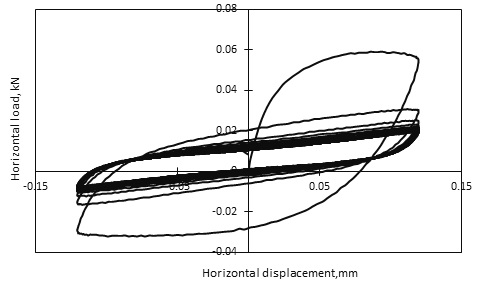
Horizontal load versus horizontal displacement
Analysis of the cyclic simple shear test data:
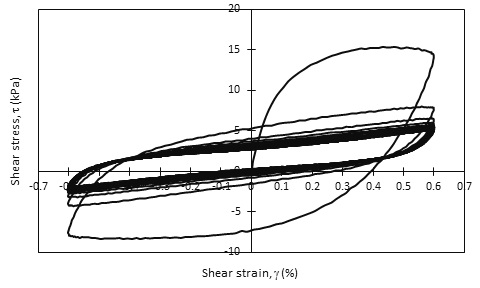
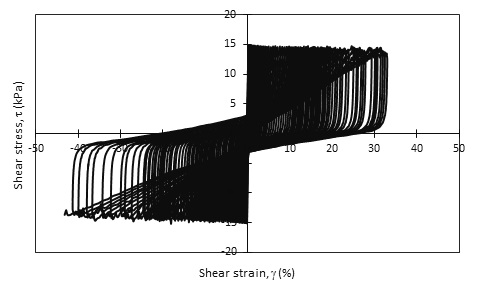
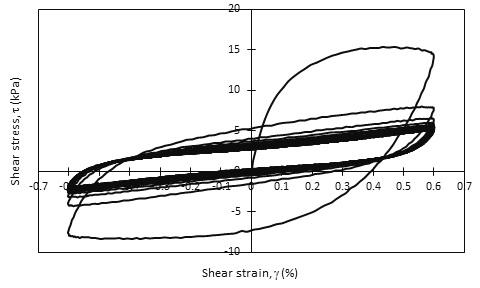
Shear stress versus Shear strain curve (Hysteresis loop)
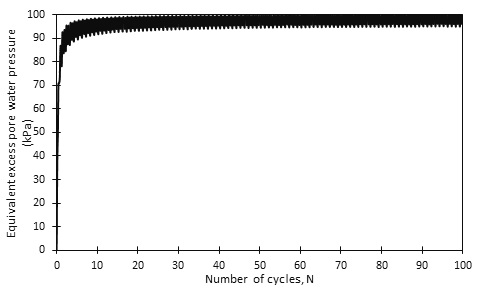
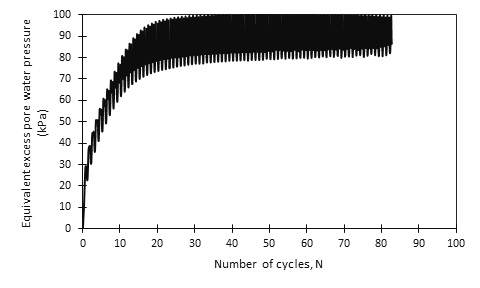
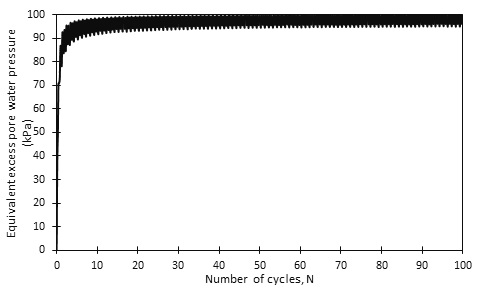
Equivalent excess pore pressure versus Number of Cycles
Example:
A cyclic simple shear test was performed on silty-sand. The in-situ density and in-situ water content was 1.6 gm/cc and 8 % respectively. The shear strength parameters was c=0 kPa & F = 29 deg. The strain controlled cyclic simple shear test was performed on specimens at 0.1 Hz frequency and 0.12 mm displacement amplitude. The size of the specimen was 70 mm diameter and 20 mm height. The specimen was consolidated at vertical pressure of 100 kPa and
Input curve: Horizontal displacement versus Time
Output curve: Horizontal load vs horizontal displacement
Analysis of cyclic simple shear test data
i. Shear stress versus Shear strain (Hysteresis loop)
ii. Equivalent excess pore pressure versus Number of cycles
(pore pressure ratio = equivalent excess pore pressure/initial vertical stress;
At 20th cycle, pore pressure ratio is 1, which indicates that soil has liquefied.)
Cyclic Simple Shear
Result
Theory:
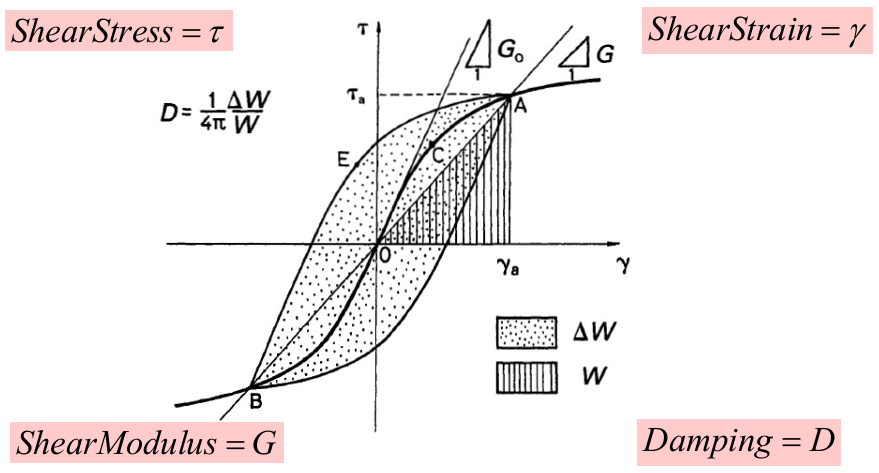
The first five cycles are usually considered for calculating shear modulus and damping ratio. The values for the first cycle are:
G = 2385 kPa
D = 35 %
The specimen exhibited cyclic liquefaction in 20 cycles. The pore water pressure reached the vertical normal stress of 100 kPa indicating a state of zero effective stress. The soil showed liquefaction in 20 cycles for cyclic simple shear loading of 0.12 mm horizontal displacement amplitude at 0.1 Hz frequency. Shear strain corresponding to 0.12 mm horizontal displacement is 0.6 %.
- CRR can only be evaluated from Stress-Controlled CSS Data
- Cyclic Stress Ratio, CSR = 𝝉/𝝈𝒗
τ = Amplitude of Stress-controlled loading (Shear stress in kPa)
𝜎𝑣 = Applied effective vertical overburden pressure
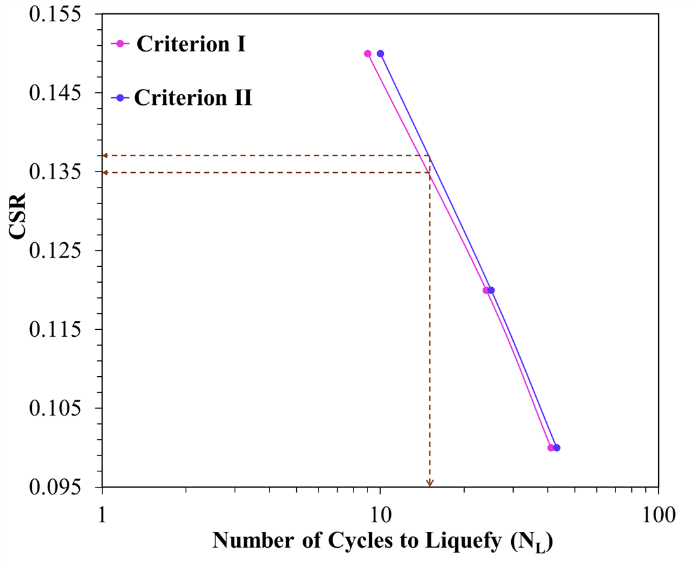
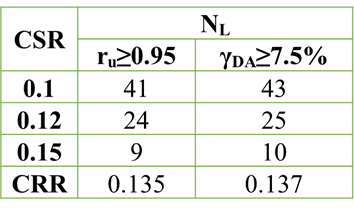
- Minimum 3 tests should be performed at different CSR to determine the CRR of the soil
- Input loading for Stress-Controlled Cyclic Loading:
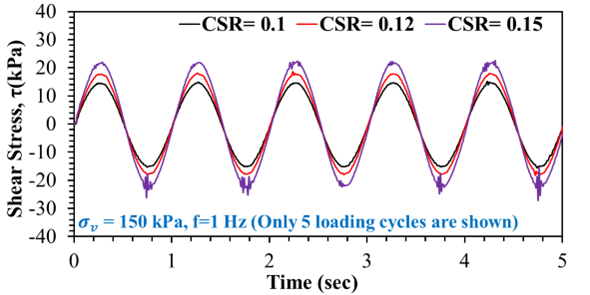
- Output loading for Stress-Controlled Cyclic Loading:
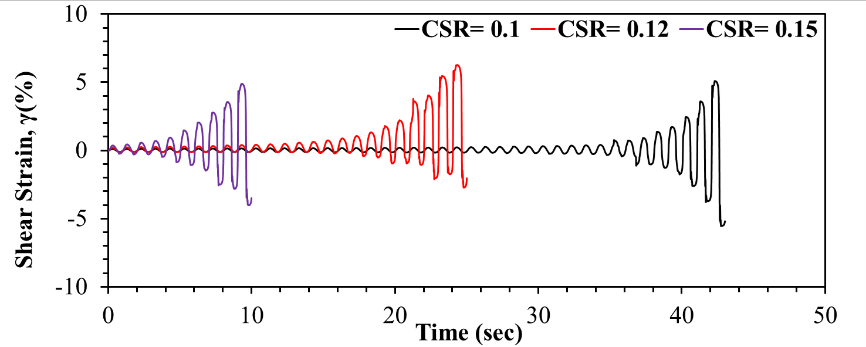
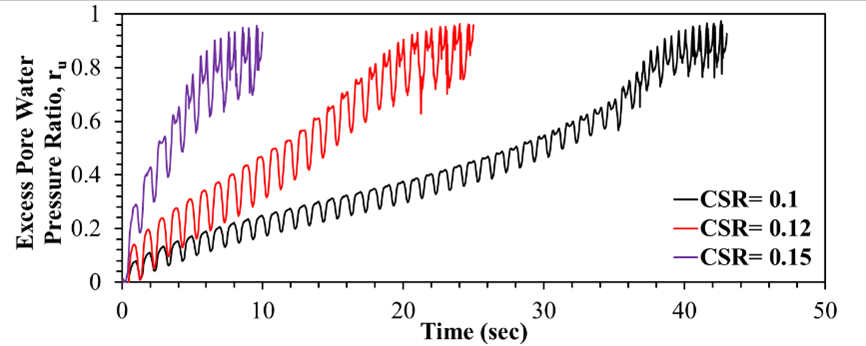
- Liquefaction Criteria:
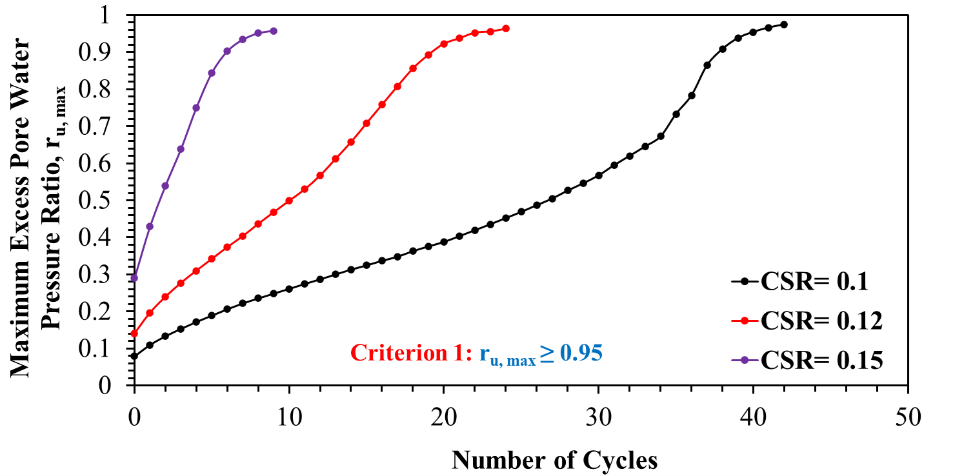
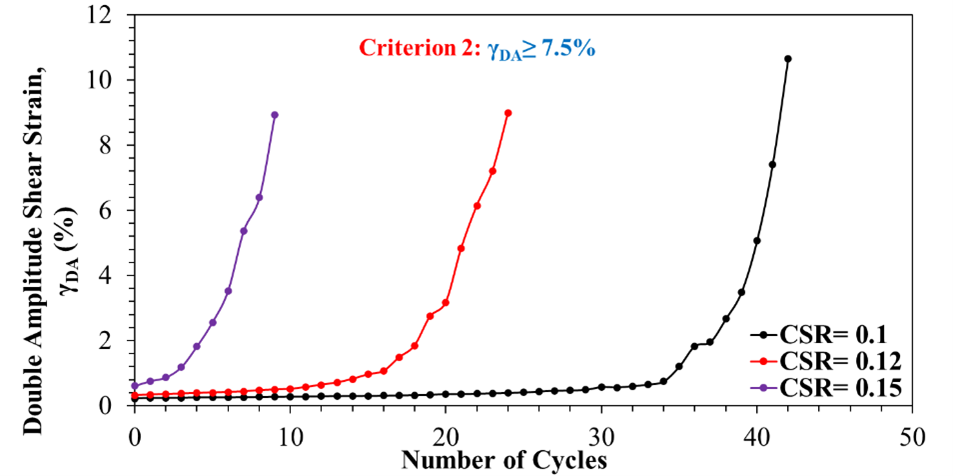
Number of cycles required to liquefy the specimen (NL) can be determined using following criteria:
- Criterion 1: ru, max ≥ 0.95
- Criterion 2: γDA ≥ 7.5%
ru, max = Maximum excess pore water pressure ratio
γDA = Double amplitude shear strain
- Liquefaction Resistance:
Cyclic resistance ratio (CRR) is evaluated as the Cyclic stress ratio required to initiate liquefaction in 15 cycles (Mw = 7.5).
Special Note:
Same procedure can be followed for Stress-controlled Cyclic Triaxial (CTX) tests with the following changes:
- CSR= (σd= Amplitude of cyclic deviatoric stress, σc= Effective confining pressure)
- Criterion 1: ru, max ≥ 0.95 (Same as CSS test)
Criterion 2: Double amplitude axial strain, εDA ≥ 5%